
Netherlands vs. Morocco: A Defining Clash of Philosophies
The Netherlands and Morocco meet in one of the most intriguing knockout ties of the 2026 World Cup. A place in the round of 16 hangs in the balance, and the loser faces immediate elimination. On paper, two sides in strong form collide, but this is also a clash of identities: Dutch control and structure versus Moroccan athleticism, defensive discipline, and speed in transition.
Match Overview & Stakes
This marks the new round of 32, but the stakes mirror any World Cup knockout game: win and move on, lose and go home. Both teams reached this stage unbeaten and level on seven points, giving the match a deceptively even feel despite the historical weight attached to both nations. The winner advances to the round of 16, where the bracket could present an even more severe path. Morocco arrives with added symbolism; the Atlas Lions have a history of making a huge splash on the world stage. In 1986, they became the first African team to win a World Cup group and advance to the knockout stage. In 2022, they became the first African and first Arab team to reach a World Cup semi-final, and they naturally hope to push further this time.
How they got here: Netherlands vs. Morocco
The Netherlands played with efficiency rather than electricity in the group stage. Their three games followed a clear tactical pattern: patience in possession, dangerous wide play, and individual quality to maintain control. Although the Netherlands drew arguably one of the trickiest groups, they topped their quartet to secure this spot. They opened with a 2-2 draw against Japan—their toughest group match—before beating Tunisia 3-1 and Sweden 5-1.
The latter two games demonstrated how quickly they punish loose defending once the game opens up. Ronald Koeman will likely field a 4-3-3 or a close variation, with Bart Verbruggen behind a back four of Denzel Dumfries, Jan Paul van Hecke, Virgil van Dijk, and Micky van de Ven. Frenkie de Jong will anchor a midfield designed to dictate the tempo. In the final third, Cody Gakpo and Donyell Malen provide directness, while Brian Brobbey offers a physical focal point if Koeman needs a target in the box.
Morocco’s route felt less smooth but proved more impressive tactically, as they navigated different game states while remaining unbeaten. Their opening draw against Brazil stood out; the Atlas Lions controlled large spells, only failing to score due to a moment of brilliance from Vinícius Júnior. They then edged Scotland 1-0 before producing a chaotic 4-2 win over Haiti, a match that highlighted both their attacking ceiling and their defensive vulnerability when the game stretches.
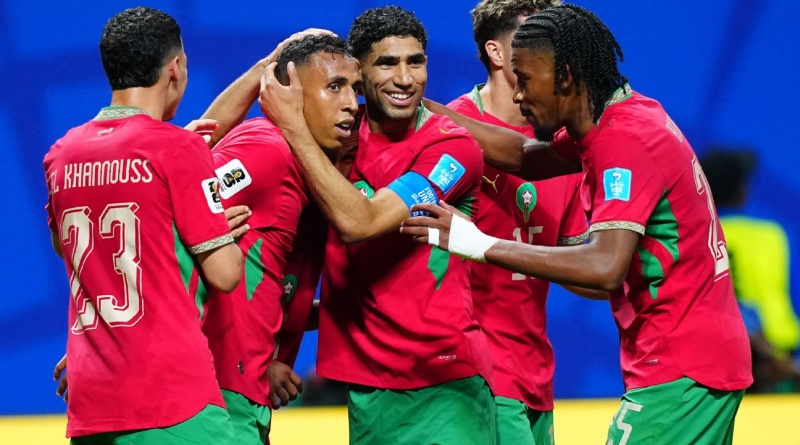
Morocco will likely set up in a 4-3-3 or 4-2-3-1 hybrid, with Yassine Bounou in goal. Achraf Hakimi and Noussair Mazraoui will provide width from the full-back positions, while Brahim Díaz, Ismael Saibari, and Bilal El Khannouss will supply creativity between the lines. Morocco enters this tournament with strong momentum; they currently sit seventh in the FIFA rankings and have not lost a game in any competition since falling 1-0 to Kenya on August 10, 2025.
Tactical Battles
The pivotal duel will likely feature Hakimi against the Netherlands’ left side, particularly if Gakpo and van de Ven must help contain his forward bursts. Morocco’s most potent attacking weapon involves exploiting the space behind the opposition full-back, and Hakimi’s timing in transition can force the Dutch back line to retreat rather than step up and compress the pitch. This matters because the Netherlands prefer building through control; if Morocco’s midfield successfully screens the lanes for de Jong, the Dutch attack may become too horizontal. On the other side, the Netherlands will try to isolate Morocco’s central defenders when Dumfries or Reijnders arrive late into the box, as Morocco’s full-backs may gamble by pushing high, leaving gaps behind.
Final Verdict & Prediction
Fine margins, rather than a wide-open shootout, will likely decide this game. The Netherlands possess deeper structure and more proven knockout pedigree, but Morocco’s form, ranking, and ability to handle elite opponents suggest they will remain competitive late into the match. A draw after 90 minutes feels plausible, yet the Dutch hold enough balance across the pitch to edge it if the game turns into a test of chance creation rather than transition chaos.
Prediction: Netherlands 2-1 Morocco